The journey from the beginning of lacquer to kintsugi
When explaining kintsugi, we often talk about lacquerware. On this page, I have written about the origins of lacquerware, the evolution of lacquerware techniques that led to the development of kintsugi, and my personal views on the future of kintsugi. Please take a look.
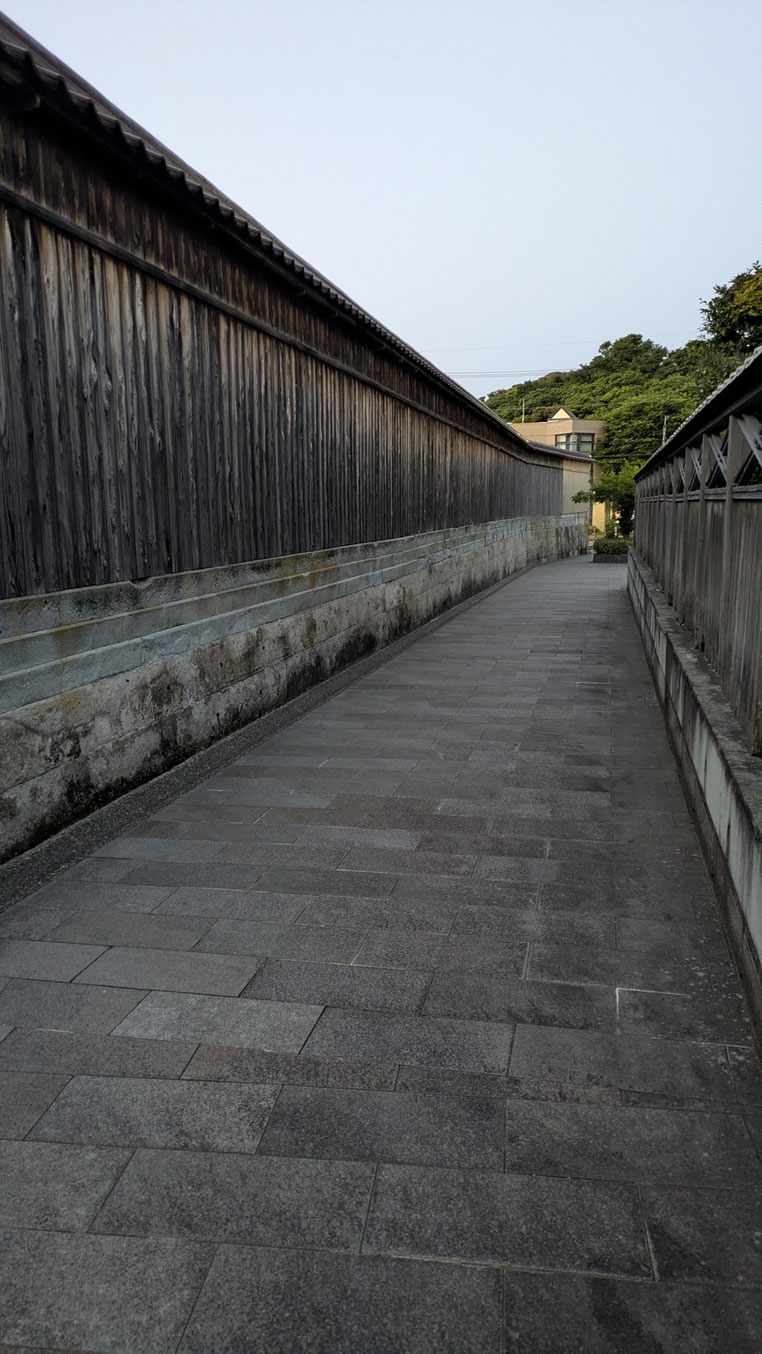
Japanese lacquer culture began about 6,000 years ago
when lacquer was applied to wood to make it waterproof. Later, natural mineral pigments were mixed with lacquer and lacquer began to be used for decorative purposes.
Buddhist statues begin to be made with lacquer

Then time moves on.About 1,300 years ago, during the Nara period, people began making Buddhist statues using lacquer, clay, and cloth. When clay is mixed well with liquid lacquer, it becomes clay-like lacquer. This lacquer hardens considerably when it dries. Clay-like lacquer was suitable for creating detailed parts such as faces when applied with a spatula. However, lacquer was a valuable commodity even at that time, so this technique for making Buddhist statues did not continue for long.
※In our kintsugi experience, you will use this clay-like lacquer to fill in cracks and grooves. Touch the lacquer, soil, and cloth with your hands to feel how hard it is!
The technique of carving wood also developed.
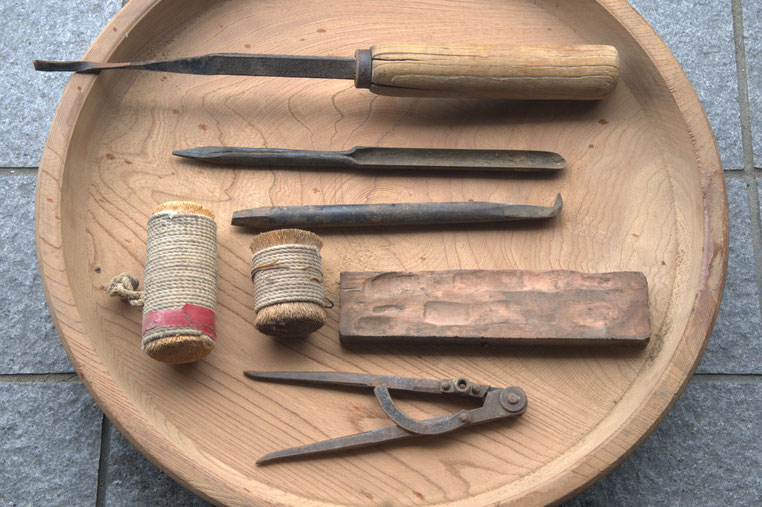
As time progressed, mass production became possible with the technology of shaving wood with a lathe, and lacquerware began to spread among the common people. Along with this, lacquerware techniques also evolved. My hometown of Yamanaka Onsen has had an industry specializing in wood shaving techniques and lacquerware since the Azuchi-Momoyama period about 400 years ago.
※The photo shows tools used by craftsmen to carve wood. You can actually hold and see the tools used in the autumn kintsugi experience.
When did kintsugi begin?
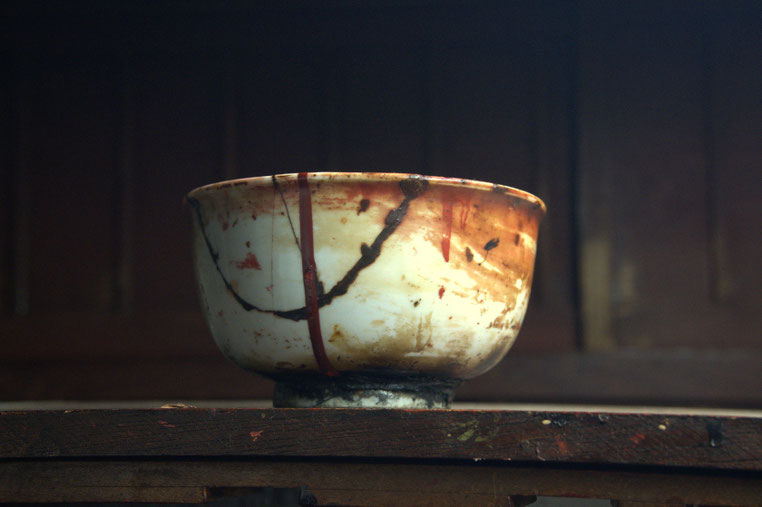
Please look at the photo of the vessel. This vessel has been used by lacquer craftsmen for decades. It is cracked, chipped, and broken. Over time, lacquer has seeped into the cracks and chips, repairing them. I believe that the beginning of kintsugi was when gold was added to the repaired areas.
The culture and period in which kintsugi was born
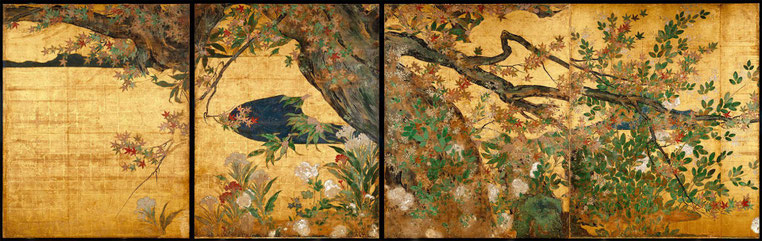
Damaged vessels were repaired using lacquer as an adhesive. At the time, it was natural to continue using them while repairing them. I believe that the practice of inserting gold into the repair marks began during the Momoyama period, when a luxurious aesthetic sense blossomed. Gold leaf was also used in paintings of the time, and it was a vibrant culture where tea ceremonies flourished. I think the origins of kintsugi lie in the deliberate choice to fill cracks with gold, enjoying the broken patterns as accidental landscapes, driven by a heightened sense of aesthetic beauty.
Not restoring, but creating new beauty.
Kintsugi was once a technique quietly passed down among a select few lacquer craftsmen,
but with the development of the internet, its beauty and philosophy became widely known, and kintsugi evolved from a quiet boom into a global movement.
Furthermore, with advances in technology and freedom of expression, materials other than gold began to be used, expanding the range of expression.
Restoration is no longer simply a matter of “returning to the original state,” but has evolved into an act of “creating new beauty.”
Why not come to our workshop and experience something new?
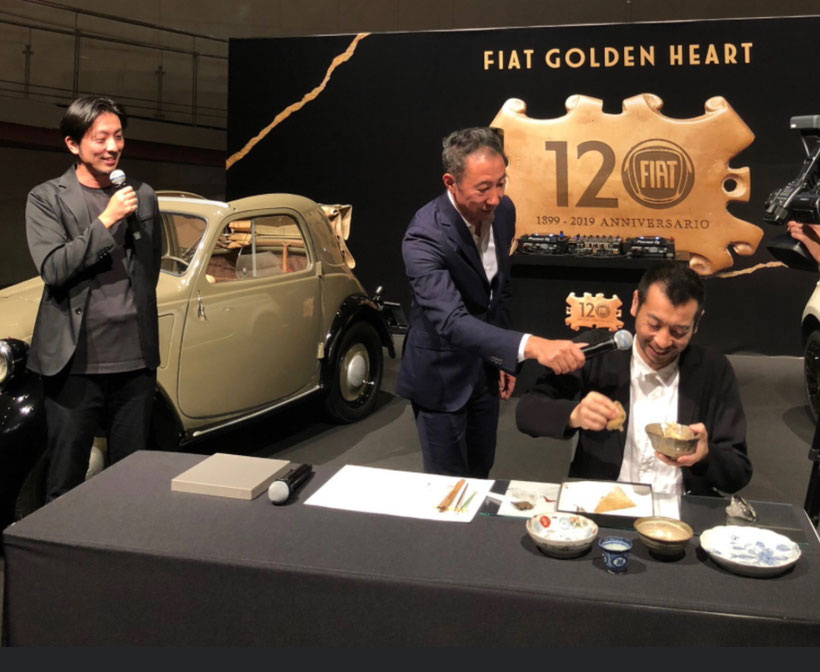
※This photo was taken by Yagi, who organizes kintsugi workshops, when Fiat and kintsugi collaborated with the aim of imagining new beauty.